Key takeaways
The 30-second version
- An AIP meal plan removes grains, legumes, dairy, eggs, nightshades, nuts, seeds, coffee, alcohol and food additives for a few weeks, then adds foods back one at a time to find your triggers.
- This page gives you a full 7-day plan, a shopping list and a 2.5-hour batch-cooking routine so you are not cooking three times a day.
- In small studies, AIP helped symptoms: 11 of 15 people with Crohn's or colitis reached remission, and women with Hashimoto's felt much better. It did not lower thyroid antibodies.
- The biggest risks are low calcium and iodine. Eat canned salmon or sardines with the soft bones, use iodized salt, and include liver and seafood every week.
- Stay in the strict phase about 30 to 90 days, not forever. Keep taking your medication, and talk to your doctor before you start, especially if you have bowel narrowing or take thyroid hormone.
Want a version built around your symptoms and labs?
Take the 3-min quiz →An AIP meal plan is a structured week of meals that follows the elimination phase of the Autoimmune Protocol: meat, seafood, vegetables, fruit, healthy fats and fermented foods, with no grains, legumes, dairy, eggs, nightshades, nuts, seeds, coffee, alcohol, refined sugar or additives. The two clinical studies most often cited for AIP, Konijeti et al. 2017 in inflammatory bowel disease and Abbott et al. 2019 in Hashimoto's thyroiditis, used exactly this food list for 6 weeks, held it for another 4 to 5 weeks, and paired it with coaching on sleep, stress and movement. The plan below follows the same rules, built for a working adult who has one afternoon a week to cook.
If you want the why behind each eliminated food, read our AIP diet guide for Hashimoto's. If you are still choosing between AIP, Mediterranean, SCD or Wahls, start with the autoimmune diet comparison. This article is the practical layer: what to buy, what to cook, and what the studies say can go wrong.
What the AIP Studies Actually Fed People
Most AIP meal plans online are written from a recipe blog's point of view. The research protocol is more specific, and it shapes how a sensible plan should look.
Konijeti et al. 2017: AIP in Crohn's and ulcerative colitis
Konijeti and colleagues at Scripps Clinic ran an open-label pilot in 15 adults with active IBD (9 Crohn's, 6 ulcerative colitis), published in Inflammatory Bowel Diseases. Participants followed a 6-week elimination phase, then a 5-week maintenance phase with no reintroduction. A certified health coach led the program with input from a registered dietitian, and participants logged their food and joined a private online group.
By week 6, 11 of 15 participants (73%) were in clinical remission, and all 11 stayed in remission through week 11 (Konijeti et al., 2017). Fecal calprotectin fell from a mean of 471 to 112 µg/g, though that drop did not reach statistical significance. Seven of the 15 had follow-up endoscopy, and the authors reported improvement in six. Weight did not change significantly, and nearly half the group was on biologics throughout.
Abbott et al. 2019: AIP in Hashimoto's
Abbott, Sadowski and Alt studied 16 women with Hashimoto's in a 10-week online program called "SAD to AIP in SIX," published in Cureus. Foods were removed and added in weekly stages over 6 weeks, followed by 4 weeks of maintenance. The added foods were deliberate: seafood, organ meats, bone broth, fermented foods and more mono- and polyunsaturated fats.
Symptom burden on the Medical Symptoms Questionnaire dropped from 92 to 29, and all eight quality-of-life domains on the SF-36 improved (Abbott et al., 2019). Mean hs-CRP fell from 1.63 to 1.15 mg/L. TSH, free T4, TPO antibodies and thyroglobulin antibodies did not change significantly. Average weight fell about 6 pounds.
Design lessons for a meal plan
Three design choices follow from the research. First, the studies added nutrient-dense foods (seafood, organ meat, broth, fermented vegetables) as deliberately as they removed problem foods, so a good plan schedules them rather than leaving them optional. Second, both programs eased people in over weeks instead of switching overnight. Third, neither study tested reintroduction, so the plan has to end with a clear exit into the reintroduction phase.
The Evidence Grade for an AIP Meal Plan
Each piece of the plan carries a grade on our standard scale. Grade A means multiple RCTs or meta-analyses, Grade B means a single RCT or consistent pilot data with a plausible mechanism, and Grade C means preliminary or mechanistic evidence.
| Component | Grade | What the evidence shows |
|---|---|---|
| AIP elimination for IBD symptoms | B | 73% clinical remission in an uncontrolled pilot of 15 (Konijeti 2017) |
| AIP elimination for Hashimoto's symptoms and quality of life | B | Large symptom and SF-36 improvements in 16 women, no control group (Abbott 2019) |
| AIP for lowering thyroid antibodies | C | No change in Abbott 2019; TPO antibodies rose in Ihnatowicz 2023 |
| Planning for calcium and iodine | B | Paleo-pattern diets cut calcium and iodine intake (Genoni 2016) and halved urinary iodine (Manousou 2018) in randomised trials; not tested on AIP itself |
| Weekly seafood and organ meat | C | Nutrient density is well established; no autoimmune-specific trials |
| Bone broth and fermented vegetables | C | Part of the studied protocols, never tested on their own |
The Grade B ratings rest on small, open-label studies. They justify a time-limited trial with careful tracking. They do not justify promising anyone a specific result.
Is There an "Autoimmune Reversal Meal Plan"?
People search for an "autoimmune reversal meal plan" and an "autoimmune disease reversal diet" because they want a way out. No meal plan has been shown to reverse autoimmune disease, and anyone selling one is overstating the data.
The honest picture comes from the antibody results. In Abbott 2019, TPO antibodies went from 225 to 219 IU/mL, a change indistinguishable from noise. In a 12-week Polish study of 28 euthyroid people with Hashimoto's, Ihnatowicz and colleagues reported fewer symptoms on AIP, but TPO antibodies increased significantly and body weight fell, which the authors read as a calorie deficit (Ihnatowicz et al., 2023). The IBD remissions in Konijeti 2017 were clinical remissions measured by symptom scores, in people who mostly stayed on their medication.
What AIP can do is lower symptom load and help you identify individual food triggers that you then avoid long term. That is management, and it is worth doing well. For a longer discussion of what remission means and which interventions move antibodies, see Can You Reverse Hashimoto's?.
Before You Start: The Two-Week Ramp
Both research programs eased participants in, and Abbott 2019 added a two-week washout period before the elimination began. Switching overnight from a typical diet to full AIP is the most common reason people quit in week one: no coffee, no eggs, no bread, and nothing in the fridge.
A simple ramp:
- Week minus 2: cut alcohol, refined sugar and packaged snacks. Taper coffee by half a cup every few days to soften caffeine withdrawal headaches. Use up grains and legumes in the pantry.
- Week minus 1: drop dairy, eggs, nuts and seeds. Replace morning eggs with meat patties. Buy the pantry staples on the shopping list below and do one trial batch-cook.
- Day 1: remove nightshades and seed spices (including black pepper, paprika, chili and cumin), and start the 7-day plan.
Use the reference below to check any food you are unsure about.
AIP Elimination Phase — Food Guide
AIP Allowed
- 🥩Grass-fed & wild-caught meat
- 🐟Wild-caught fish & seafood
- 🫀Organ meats (liver, heart, kidney)
- 🥦All non-nightshade vegetables
- 🍠Sweet potato & starchy tubers
- 🥥Coconut products (oil, milk, flour)
- 🥑Avocado & avocado oil
- 🫙Olive oil, lard, tallow
- 🍖Bone broth
- 🌿Fresh & dried herbs (non-seed)
- 🍓All fruits (moderate portions)
- 🥬Fermented vegetables (sauerkraut, kimchi)
AIP Eliminated
- 🌾All grains (wheat, rice, oats, corn)
- 🫘Legumes (beans, lentils, peanuts, soy)
- 🥛All dairy products
- 🥚Eggs (whole — including yolk)
- 🍅Nightshades (tomato, pepper, eggplant)
- 🌰Nuts (all varieties)
- 🌻Seeds (including seed-based spices)
- 🍷Alcohol
- 💊NSAIDs (ibuprofen, naproxen, aspirin)
- 🧪Food additives & emulsifiers
- ☕Coffee & caffeine
- 🍬Refined sugars & sweeteners
The 7-Day AIP Meal Plan
The plan is built for one adult and organised around two cooking sessions: a main batch-cook on Day 7 (for the following week) and a 45-minute top-up on Day 4. Most lunches are leftovers. Most dinners either come from the batch or take under 30 minutes.
7-Day AIP Meal Plan: Elimination Phase
No grains, legumes, dairy, eggs, nightshades, nuts, seeds, coffee, alcohol or additives
| Day | Breakfast | Lunch | Dinner | Snack |
|---|---|---|---|---|
Day 1 | Turkey-sage patties, sautéed spinach in olive oil, half an avocado | Shredded roast chicken over greens, roasted sweet potato, lemon-herb dressing, sauerkraut | Beef and root vegetable stew (carrot, parsnip, onion, thyme) | Apple slices with toasted coconut flakes |
Day 2 | Breakfast hash: crumbled patties, roasted roots, wilted kale | Chicken salad in collard or lettuce wraps with cucumber, olives, avocado mash | Pan-seared salmon, roasted broccoli, cauliflower mash with olive oil | Mug of bone broth, carrot sticks with guacamole |
Day 3 | Turkey patties, sautéed zucchini with garlic, a handful of berries | Beef stew leftovers with a side of arugula | Liver-boosted beef meatballs (10 to 15% blended liver), roasted butternut squash, garlicky greens | Sardines (with bones) on cucumber rounds with lemon |
Day 4 Midweek mini-prep (45 min) | Breakfast soup: bone broth, shredded chicken, spinach, fresh ginger | Meatball leftovers over mixed greens with lemon-herb dressing | Slow-cooker pork shoulder with apples and onions, roasted asparagus | Pear or apple, a few olives |
Day 5 | Pork and sweet potato hash with kale | Canned salmon cakes (salmon with bones, mashed sweet potato, herbs), side salad | Ginger-turmeric chicken thighs simmered in coconut milk, cauliflower rice, sauerkraut | Plantain chips (check the oil) with guacamole |
Day 6 | Leftover salmon cakes, avocado, sauerkraut | Coconut chicken leftovers over cauliflower rice | Shrimp or white fish in lettuce cups with mango-cilantro-cucumber slaw | Smoked oysters (in olive oil) on cucumber slices |
Day 7 Main batch-cook day for next week | Turkey patties from the freezer, sautéed greens, berries | Clean-out-the-fridge salad: every leftover protein and vegetable, olive oil, vinegar | Roast chicken with roasted roots (start next week’s batch) | Coconut yogurt (no gums or additives) with berries, or bone broth |
Day 1
- Breakfast
- Turkey-sage patties, sautéed spinach in olive oil, half an avocado
- Lunch
- Shredded roast chicken over greens, roasted sweet potato, lemon-herb dressing, sauerkraut
- Dinner
- Beef and root vegetable stew (carrot, parsnip, onion, thyme)
- Snack
- Apple slices with toasted coconut flakes
Day 2
- Breakfast
- Breakfast hash: crumbled patties, roasted roots, wilted kale
- Lunch
- Chicken salad in collard or lettuce wraps with cucumber, olives, avocado mash
- Dinner
- Pan-seared salmon, roasted broccoli, cauliflower mash with olive oil
- Snack
- Mug of bone broth, carrot sticks with guacamole
Day 3
- Breakfast
- Turkey patties, sautéed zucchini with garlic, a handful of berries
- Lunch
- Beef stew leftovers with a side of arugula
- Dinner
- Liver-boosted beef meatballs (10 to 15% blended liver), roasted butternut squash, garlicky greens
- Snack
- Sardines (with bones) on cucumber rounds with lemon
Day 4
Midweek mini-prep (45 min)- Breakfast
- Breakfast soup: bone broth, shredded chicken, spinach, fresh ginger
- Lunch
- Meatball leftovers over mixed greens with lemon-herb dressing
- Dinner
- Slow-cooker pork shoulder with apples and onions, roasted asparagus
- Snack
- Pear or apple, a few olives
Day 5
- Breakfast
- Pork and sweet potato hash with kale
- Lunch
- Canned salmon cakes (salmon with bones, mashed sweet potato, herbs), side salad
- Dinner
- Ginger-turmeric chicken thighs simmered in coconut milk, cauliflower rice, sauerkraut
- Snack
- Plantain chips (check the oil) with guacamole
Day 6
- Breakfast
- Leftover salmon cakes, avocado, sauerkraut
- Lunch
- Coconut chicken leftovers over cauliflower rice
- Dinner
- Shrimp or white fish in lettuce cups with mango-cilantro-cucumber slaw
- Snack
- Smoked oysters (in olive oil) on cucumber slices
Day 7
Main batch-cook day for next week- Breakfast
- Turkey patties from the freezer, sautéed greens, berries
- Lunch
- Clean-out-the-fridge salad: every leftover protein and vegetable, olive oil, vinegar
- Dinner
- Roast chicken with roasted roots (start next week’s batch)
- Snack
- Coconut yogurt (no gums or additives) with berries, or bone broth
How the week is structured
Every meal has a palm-and-a-half of protein, at least two vegetables and a fat. Seafood appears six times across the week, bone-in canned fish twice, liver once and sauerkraut three times. That frequency is deliberate: it covers the specific nutrient gaps discussed further down.
Starch comes from sweet potato, squash, parsnip, carrots, plantain and fruit. Without these, AIP can drift into an accidental low-carbohydrate diet, which some people tolerate poorly, especially with thyroid disease or heavy training.
AIP breakfast ideas
Breakfast is the hardest meal on AIP. Eggs, oats, yogurt, toast and coffee are all gone, and that is most of the standard menu. The fix is to stop thinking in breakfast foods and eat dinner food in the morning.
Reliable AIP breakfast ideas:
- Turkey-sage patties from the batch, reheated in a pan with a handful of spinach. Five minutes.
- Breakfast hash: leftover pork, beef or chicken crisped with roasted sweet potato and kale.
- Breakfast soup: a mug of bone broth with shredded chicken, greens and grated ginger. Good on mornings when appetite is low.
- Salmon cakes from canned bone-in salmon, mashed sweet potato and herbs, made ahead and eaten cold or warm.
- Leftovers: last night's stew or meatballs. This sounds odd until you try it.
Smoothies built on coconut milk and fruit are AIP-compliant but light on protein. If you use one, add a real protein source on the side. Collagen powder is allowed on AIP, but it is an incomplete protein and should not be your only protein at a meal.
Batch-Cooking Plan: 2.5 Hours on Day 7
Batch cooking is what separates people who finish the elimination phase from people who stop on day 5. The goal is to have cooked protein, roasted vegetables and broth ready before the week starts.
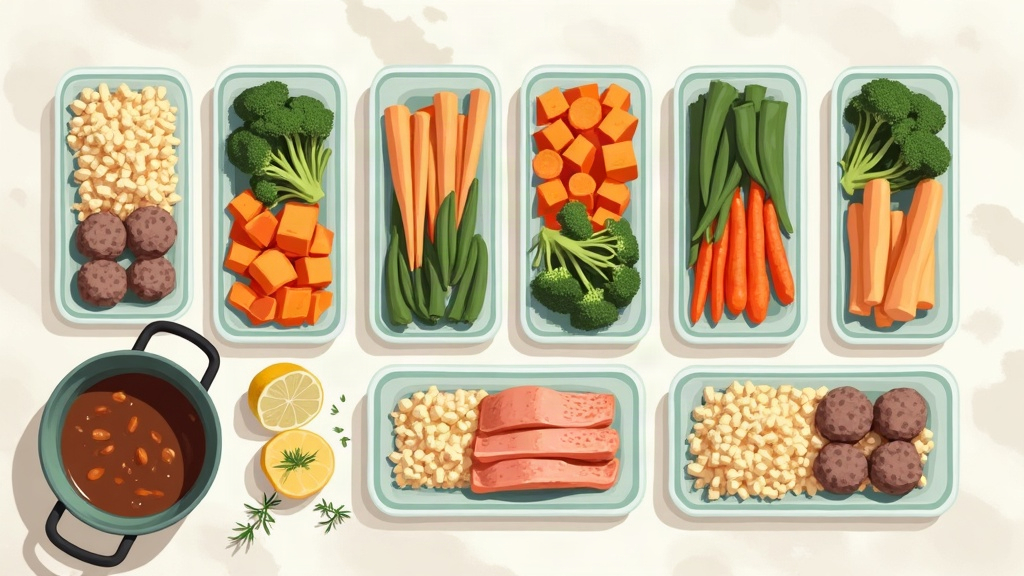
The main session (about 2.5 hours, mostly hands-off)
Run these in parallel, in this order:
- Start the stew (15 minutes active). Brown 1.5 lb beef chuck in a slow cooker or Dutch oven with onion, garlic, carrot, parsnip, thyme and bone broth. Let it simmer for the rest of the session. This gives you four portions.
- Roast the chicken (10 minutes active). A whole chicken or bone-in thighs with olive oil, salt, rosemary and lemon. When it cools, shred the meat and save the bones for broth.
- Make the turkey patties (20 minutes active). Mix 2 lb ground turkey with salt, dried sage, thyme, garlic and a little grated apple for moisture. Form about 14 patties and bake on a sheet pan. Freeze half.
- Roast two vegetable trays (15 minutes active). One tray of sweet potato, carrot and parsnip; one tray of broccoli or cauliflower. Olive oil or avocado oil and salt.
- Wash and prep greens, and make a dressing (15 minutes). Whisk olive oil, lemon juice, garlic and chopped herbs in a jar. It keeps five days in the fridge.
Portion everything into containers before you clean up. Food that is already portioned gets eaten; a large tub of stew gets ignored.
The midweek top-up (Day 4, about 45 minutes)
Put the pork shoulder in the slow cooker with sliced apple and onion in the morning. In the evening, roast asparagus and squash, and mix the salmon cakes for Day 5 and Day 6. (For the Day 3 meatballs, blend about 2 to 3 oz of liver into 1 lb of ground beef; at roughly 10 to 15% liver, most people barely taste it.)
Storage
Cooked meat and stew keep about three to four days in the fridge. Anything for Days 5 to 7 should go in the freezer on Day 7 and move to the fridge the night before you need it.
AIP Shopping List
This list covers the 7-day plan above for one adult. Pantry staples are bought once and last several weeks.
AIP Shopping List: One Adult, One Week
Matches the 7-day meal plan above. Quantities are approximate.
Protein
- Whole chicken or bone-in thighs4 to 5 lb
Thighs cost less per pound than breasts
- Boneless chicken thighs1.5 lb
- Ground turkey2 lb
Freeze half the patties
- Beef chuck (stew meat)1.5 lb
- Ground beef1 lb
- Beef or chicken liver2 to 3 oz
Among the cheapest cuts; freeze the rest of the pack
- Pork shoulder1.5 to 2 lb
- Salmon fillets (fresh or frozen)2 x 6 oz
- Shrimp or white fish (frozen)12 oz
Canned and Jarred
- Wild salmon, bones in2 cans
Soft bones are a non-dairy calcium source
- Sardines, bones in1 to 2 cans
- Smoked oysters in olive oil1 can
- Bone broth2 quarts
Skip if it lists pepper, sugar or yeast extract
- Full-fat coconut milk1 to 2 cans
Brands without guar gum exist
- Raw sauerkraut (refrigerated)1 jar
- Olives1 jar
Vegetables
- Sweet potatoes3 lb
- Carrots and parsnips2 lb + 1 lb
- Butternut squash1
- Onions, garlic, fresh ginger4, 2 heads, 1 knob
- Spinach and kale2 bags + 1 bunch
Frozen spinach works for cooked meals
- Arugula or mixed greens2 clamshells
- Broccoli and cauliflower2 heads + 1 head
Frozen florets are fine
- Zucchini, cucumber, asparagus3, 3, 1 bunch
- Collard or butter lettuce leaves1 bunch
Fruit and Fresh Herbs
- Avocados4 to 5
- Apples or pears5
- Berries2 cups
Frozen berries cost less
- Mango1
- Lemons and limes4 + 2
- Plantains (optional)2
- Parsley, cilantro, thyme, sage, rosemary1 bunch each
Pantry Staples (buy once)
- Extra-virgin olive oil, avocado oil, coconut oil1 each
- Apple cider vinegar1 bottle
- Iodized salt1 container
Plain sea salt carries little iodine
- Dried herbs: oregano, thyme, rosemary, turmeric, ginger, cinnamonsmall jars
- Coconut aminos1 bottle
- Unsweetened coconut flakes1 bag
- Cassava flour or arrowroot (optional)1 bag
Read Labels For
- Black pepper, paprika, chili, cumin, coriander, mustard seed
- Gums, carrageenan, "natural flavors" with unclear sources
- Seed oils (canola, sunflower, soybean) on chips and broths
- Egg, dairy or nut derivatives in "paleo" products
Label traps
The elimination phase fails more often on hidden ingredients than on obvious ones. Store-bought bone broth often contains black pepper or yeast extract. Plantain chips and "paleo" crackers are usually fried in sunflower or canola oil. Spice blends almost always contain seed spices such as cumin, coriander or mustard. "AIP-friendly" coconut yogurt can still contain gums. Read every label in the first two weeks; after that you will know which brands you trust.
Budget Tips for AIP
AIP has a reputation for being expensive, and it can be if you follow the aesthetic version: grass-fed steaks, fresh wild fish, specialty flours and branded snacks. The studied protocols did not require any of that.
Ways to keep the weekly cost close to a normal whole-food shop:
- Buy the cheaper cuts. Chicken thighs, ground beef and turkey, pork shoulder and beef chuck all work well in batch cooking. Liver is one of the cheapest items in the meat case and one of the most nutrient-dense.
- Use frozen. Frozen spinach, broccoli, cauliflower, berries and fish are nutritionally comparable to fresh and remove waste.
- Lean on canned fish. Bone-in canned salmon and sardines are inexpensive, shelf-stable, and solve the calcium problem at the same time.
- Make your own broth. Save chicken carcasses and beef bones in the freezer and simmer them with vegetable scraps.
- Skip specialty products for the first month. Cassava flour, AIP crackers and baked goods are optional. A plan built on meat, vegetables and fruit does not need them.
- Prioritise quality where it counts. If the budget allows one upgrade, spend it on seafood frequency rather than on organic labels for every item.
Nutrient Risks on AIP (and How the Plan Covers Them)
Removing grains, legumes, dairy, eggs, nuts and seeds removes major sources of several nutrients. The AIP-specific research is thin on this point: Konijeti 2017 did not publish a nutrient intake analysis, and a 2024 review in Metabolism Open noted that few clinical studies have examined deficiency risk on AIP and that the existing data are contentious (Pardali et al., 2024). The best data come from trials of Paleolithic-type diets, which share most of AIP's eliminations.
Calcium
In a 4-week randomised trial of 39 healthy women, Genoni and colleagues found that a Paleolithic diet cut calcium intake by about 416 mg a day from baseline, compared with about 123 mg in the control diet (Genoni et al., 2016). The adult RDA for calcium is 1,000 mg a day (1,200 mg for women over 50), according to the NIH Office of Dietary Supplements.
AIP removes dairy entirely, so calcium has to come from bone-in canned salmon and sardines, leafy greens such as kale, bok choy and collards, and broccoli. If you cannot eat bone-in fish several times a week, ask your clinician about a calcium supplement. Bone health matters even more if you have taken corticosteroids.
Iodine
The same Genoni trial found iodine intake fell by about 56 mcg a day on the Paleolithic diet. In a 2-year randomised trial of 70 postmenopausal women, Manousou and colleagues found that median urinary iodine on a Paleolithic-type diet fell from 71 to 36 µg/L within 6 months, while it stayed stable on a standard Nordic diet (Manousou et al., 2018). The authors recommended considering iodine supplementation for anyone on a Paleo-type diet. The cause is simple: dairy and iodized salt are two of the largest iodine sources, and many AIP plans swap iodized salt for sea salt.
The plan uses iodized salt and includes seafood six times a week. For Hashimoto's, the aim is adequate iodine (the adult RDA is 150 mcg), not high doses. Avoid kelp tablets and concentrated seaweed supplements, whose iodine content varies widely and can be far above what the thyroid needs.
B vitamins
Grains are a major source of thiamin and riboflavin in fortified Western diets. Genoni 2016 recorded drops in both on the Paleo diet. In Abbott 2019, exploratory functional testing flagged possible needs for folate, riboflavin and B6 in several participants, although these case-level findings were not part of the statistical analysis. Liver, pork, leafy greens and seafood are the main AIP sources, which is why liver appears in the plan weekly. If you have Hashimoto's, B12 deserves a blood test regardless of diet, because autoimmune gastritis is more common alongside it.
Iron, zinc and selenium
Red meat, liver and shellfish make iron and zinc relatively easy on AIP. In Konijeti 2017, 6 of the 15 IBD participants needed iron repletion during the study, a reminder that in IBD, malabsorption drives deficiency as much as diet does. If you have heavy periods or IBD, check ferritin before you start; our iron deficiency in Hashimoto's guide explains the targets. Selenium is low on AIP unless you eat seafood often, because Brazil nuts are eliminated. Seafood several times a week helps. For a therapeutic selenium dose, see the selenium guide.
Vitamin D
Food barely moves vitamin D status on any diet. Konijeti 2017 started vitamin D repletion in 3 participants. Test your 25-OH-D level and supplement if needed; the vitamin D and thyroid guide has dosing ranges to discuss with your doctor.
Protein and calories
Protein is rarely the problem on AIP because every meal is built around it. Calories are. The Ihnatowicz 2023 cohort lost weight, which the authors attributed to a calorie deficit, and Abbott 2019 participants lost about 6 pounds on average. A diet low in starch and fat is easy to undereat. If you are losing weight you did not intend to lose, add more sweet potato, plantain, avocado, olive oil and coconut milk.
Fibre
AIP removes whole grains and legumes, but a plan rich in vegetables, tubers and fruit can still meet fibre needs. The exception is people with intestinal strictures. In Konijeti 2017, one participant with an ileocolonic stricture was hospitalised with a partial small bowel obstruction about three weeks in, after a large jump in raw vegetables, salad and meat. If you have Crohn's with known narrowing, cook vegetables well, purée where needed, increase fibre slowly, and work with your gastroenterologist. Our Crohn's supplement guide covers the nutrient side of IBD.
AIP as an Autoimmune Gut Repair Diet
AIP is often marketed as an "autoimmune gut repair diet." The gut rationale is real: the elimination list targets foods proposed to increase intestinal permeability or provoke immune reactions, and the add-in list (bone broth, fermented vegetables, fibre from tubers and vegetables) is aimed at the gut lining and microbiome. Konijeti 2017 is the only AIP study with direct gut measurements, and it showed falling calprotectin and endoscopic improvement in a small subgroup.
What has not been shown is that AIP measurably repairs intestinal permeability. No AIP study has measured it. If gut barrier repair is your main goal, the diet is one part of a larger approach that includes removing triggers such as NSAIDs and alcohol, addressing infections, and targeted nutrients. Our leaky gut and autoimmune protocol lays out the full 4R framework, and the L-glutamine guide covers the most-studied supplement.
How Long to Stay in the Elimination Phase
The studies give a clear range. Konijeti 2017 used 6 weeks of elimination plus 5 of maintenance. Abbott 2019 used 6 weeks of staged elimination plus 4 of maintenance. Ihnatowicz 2023 ran 12 weeks. The 2024 Pardali review reports that AIP guidance places the elimination phase anywhere from 6 weeks to 6 months.
A practical rule:
- Minimum 30 days of strict elimination, because symptom changes often take several weeks to show.
- Begin reintroduction once your symptoms have clearly improved and stayed improved for two to three weeks. For most people that falls between 30 and 90 days.
- Reassess at about 12 weeks if nothing has changed. A longer elimination phase that is not working only increases nutrient risk and social cost. Talk to your clinician about other diets or other causes.
Track symptoms during the elimination phase with a simple daily score (energy, pain, digestion, skin, sleep, each rated 1 to 10). Without a baseline record, reintroduction results are hard to read.
Transitioning to Reintroduction
Neither published AIP study tested reintroduction; both prohibited it during maintenance. The reintroduction method used in practice comes from clinical AIP guidance rather than trials, and it is where the long-term value of AIP actually comes from. Each food you successfully bring back makes the diet more varied and more sustainable.
The process: reintroduce one food at a time, eat a small amount, then a larger amount the same day, and wait several days while tracking symptoms before testing the next food. A common practice-based order starts with the foods least likely to cause reactions, such as egg yolks, ghee, seed spices and legumes with edible pods, and leaves the most common triggers (dairy, nightshades, grains) until later. This sequence is a clinical convention, not something a trial has compared against other orders, and the 2024 Pardali review notes there is no fixed rule for where to start.
AIP Reintroduction — Staged Protocol
After 30–90 days on AIP
- •Egg yolks (no whites)
- •Legume pods (green beans, snap peas)
- •Seed-based spices (cumin, coriander, fennel)
- •Fruit-based spices (black pepper, vanilla)
- •Ghee (clarified butter)
After Stage 1 foods pass
- •Seeds (pumpkin, sunflower, hemp, sesame)
- •Nuts (almonds, walnuts — not cashews)
- •Cocoa & coffee (if chosen)
- •Egg whites
- •Grass-fed butter
After Stage 2 foods pass
- •Bell peppers & paprika
- •Eggplant
- •Tomatoes
- •Chili peppers (mild first)
- •Potatoes (white)
Week 13+ (if desired)
- •Gluten-free grains (rice, quinoa)
- •Legumes (soaked & well-cooked)
- •Dairy (fermented first: yogurt, kefir)
- •Alcohol (minimal)
- •Gluten-containing grains (optional, test carefully)
How to reintroduce each food
During reintroduction, the meal plan above stays as your base. Swap in one reintroduced food at a time: egg yolks at breakfast, black pepper in the stew, a handful of seeds on a salad. For a longer menu that sits between strict AIP and a full Mediterranean diet, our thyroid healing diet has a 7-day Mediterranean-AIP hybrid plan that suits many people with Hashimoto's after reintroduction. Our AIP vs other diets guide covers the alternatives in more depth.
Safety: Who Should Take Extra Care
AIP is a food-based diet, but it is restrictive, and restriction carries risk for some people.
- History of eating disorders. Elimination diets can trigger restrictive patterns. Work with a dietitian or skip AIP in favour of a less restrictive approach.
- Intestinal strictures or recent bowel surgery. See the fibre section above. Do not attempt AIP without your gastroenterologist's input.
- Pregnancy and breastfeeding. Calcium, iodine and choline needs rise sharply, and AIP removes eggs and dairy. Do not start strict AIP without medical supervision.
- Underweight or unintentional weight loss. AIP tends to reduce calorie intake. Monitor your weight weekly.
- Thyroid medication. Six of 13 women on thyroid replacement in Abbott 2019 reduced their dose during the study. Keep taking your medication, and ask for thyroid labs after 6 to 8 weeks so your dose matches your needs. If you take levothyroxine, keep the timing between your dose and breakfast consistent; bone broth and fibre-rich meals do not change the rule.
- Immunosuppressants and biologics. There is no known interaction with AIP foods, and participants in Konijeti 2017 stayed on biologics. Do not stop or reduce medication because you feel better on the diet. Make any change with your prescriber.
- NSAIDs. AIP guidance recommends avoiding NSAIDs because of their effects on the gut lining. If you take them for pain, discuss alternatives with your doctor before stopping.
See your doctor promptly if you develop abdominal pain with vomiting or inability to pass stool, rapid weight loss, dizziness, or a flare that worsens on the diet. For a structured approach to flares, see our autoimmune flare-up guide.
Frequently Asked Questions
What do you eat for breakfast on the AIP diet?
Dinner-style food. Batch-cooked turkey or pork patties with sautéed greens, a hash of leftover meat and roasted sweet potato, bone broth soup with shredded chicken, or salmon cakes with avocado. Cooking a tray of patties once a week solves most AIP mornings.
How long should you stay on the AIP elimination phase?
The studies used 6 weeks of elimination plus 4 to 5 weeks of maintenance, and one ran 12 weeks. Aim for 30 to 90 days, start reintroduction once symptoms have clearly improved, and reassess with your clinician at about 12 weeks if nothing has changed.
Is there an autoimmune reversal meal plan?
No. AIP has improved symptoms and quality of life in small, uncontrolled studies, but it did not lower thyroid antibodies in Abbott 2019, and TPO antibodies rose in Ihnatowicz 2023. Use it to manage symptoms and identify triggers.
Can you get enough calcium and iodine on AIP?
Not without planning. Paleolithic-pattern trials found significant drops in both. Eat bone-in canned salmon or sardines, include leafy greens, use iodized salt, eat seafood several times a week, and ask your clinician about supplements.
Is AIP expensive?
It does not have to be. Chicken thighs, ground meat, liver, frozen vegetables and fish, and canned bone-in fish keep costs close to a normal whole-food shop. The expensive part is specialty AIP products, which are optional.
Can I do AIP while on medication?
Yes. Most participants in both published AIP studies stayed on their medication. Keep taking what you are prescribed and recheck labs, especially thyroid labs, after 6 to 8 weeks.
Build a Plan Around Your Condition
A generic AIP meal plan is a starting point. Your condition, your labs and your medications change which foods and nutrients matter most: a person with Crohn's and a stricture needs a different week from a woman with Hashimoto's and low ferritin. Combining the diet with the right foundation supplements, such as those in our best supplements for autoimmune disease guide, is where most people see the clearest change.
Take the free 3-minute quiz to find your personalized protocol, including diet tier, evidence-graded supplements and the labs worth checking before you start.
References
- Konijeti GG, Kim N, Lewis JD, et al. Efficacy of the Autoimmune Protocol Diet for Inflammatory Bowel Disease. Inflammatory Bowel Diseases. 2017;23(11):2054-2060. PMC5647120
- Abbott RD, Sadowski A, Alt AG. Efficacy of the Autoimmune Protocol Diet as Part of a Multi-disciplinary, Supported Lifestyle Intervention for Hashimoto's Thyroiditis. Cureus. 2019;11(4):e4556. PMC6592837
- Ihnatowicz P, Gębski J, Drywień ME. Effects of Autoimmune Protocol (AIP) diet on changes in thyroid parameters in Hashimoto's disease. Annals of Agricultural and Environmental Medicine. 2023;30(3):513-521. PMID 37772528
- Genoni A, Lyons-Wall P, Lo J, Devine A. Cardiovascular, Metabolic Effects and Dietary Composition of Ad-Libitum Paleolithic vs. Australian Guide to Healthy Eating Diets: A 4-Week Randomised Trial. Nutrients. 2016;8(5):314. PMC4882726
- Manousou S, Stål M, Larsson C, et al. A Paleolithic-type diet results in iodine deficiency: a 2-year randomized trial in postmenopausal obese women. European Journal of Clinical Nutrition. 2018;72(1):124-129. PMID 28901333
- Pardali EC, Gkouvi A, Gkouskou KK, et al. Autoimmune protocol diet: A personalized elimination diet for patients with autoimmune diseases. Metabolism Open. 2024;25:100342. PMC11755016
This site provides educational information only. Not medical advice. Always consult your healthcare provider before changing your treatment plan.