Key takeaways
The 30-second version
- A gluten free diet is essential if you have Hashimoto's plus celiac disease. About 1 in 62 people with autoimmune thyroid disease has celiac.
- If you do not have celiac, the research is mixed. One small, non-randomized study saw thyroid antibodies drop, but only in women with positive celiac antibodies (tTG). A bigger randomized trial did not.
- Test for celiac before you cut gluten. Ask for tTG-IgA and total IgA while you are still eating gluten, or the test can come back falsely normal.
- If you want to try gluten-free, run a 12-week trial: labs and symptom scores before and after, then reintroduce gluten to confirm.
- Going gluten-free can change how well you absorb levothyroxine. Ask your doctor to recheck TSH after 6 to 12 weeks. Never change your thyroid medication on your own.
Want a version built around your symptoms and labs?
Take the 3-min quiz →A gluten free diet for Hashimoto's is mandatory in one group and optional in everyone else. If you have celiac disease alongside Hashimoto's, strict gluten avoidance is standard care and often improves levothyroxine absorption (Virili et al., 2012). If you do not, the trials disagree: a six-month, non-randomized pilot in women with positive tTG antibodies found falling TPO and thyroglobulin antibodies (Krysiak et al., 2019), a 12-month randomized trial found no antibody difference versus a normal diet (Pobłocki et al., 2021), and a 2025 meta-analysis of randomized trials rated the evidence very uncertain (Araújo et al., 2025). The right move is to test for celiac first, then run a measured trial if you still want to know.
This guide reviews every trial on gluten and thyroid antibodies, explains why the order of testing matters, and gives you a 12-week plan to answer the question for your own body. For the genetics and mechanisms that connect the two diseases, see our deep dive on the celiac and Hashimoto's connection.
Hashimoto's and Gluten: Why the Question Keeps Coming Up
Hashimoto's thyroiditis and celiac disease travel together. Both are autoimmune, both cluster in families carrying the HLA-DQ2 and HLA-DQ8 genes, and each raises the odds of the other.
The best prevalence estimate comes from a 2016 meta-analysis in Thyroid. Roy and colleagues pooled 6,024 patients with autoimmune thyroid disease and found biopsy-confirmed celiac in 1.6%, or about 1 in 62 (Roy et al., 2016). The rate was 2.7% in adults in studies that looked only at adults, and 6.2% in children. In the general population, celiac affects roughly 1 in 100.
The reverse direction is stronger still. A 2016 meta-analysis of 13 studies found people with celiac had about three times the odds of thyroid disease compared with controls (Sun et al., 2016).
That overlap is the scientific root of the gluten-free advice you see everywhere. The jump from "celiac and Hashimoto's are linked" to "everyone with Hashimoto's should avoid gluten" is where the evidence gets thin.
Does Gluten Affect the Thyroid? Three Proposed Pathways
Three mechanisms get cited when people explain why gluten might matter for the thyroid. They differ sharply in how well they are supported.
1. Celiac antibodies that bind thyroid tissue
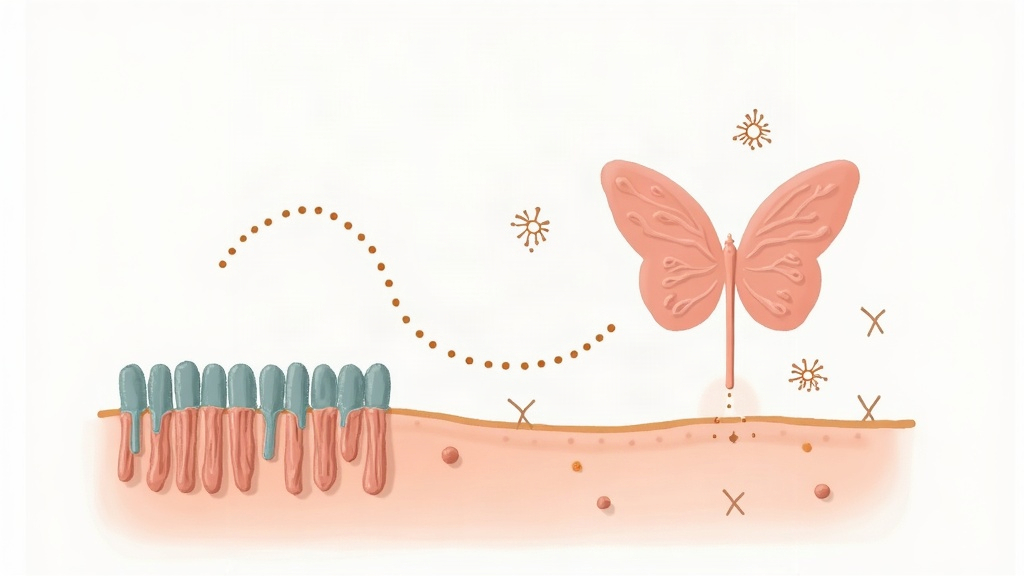
This is the best-documented link. In celiac disease, the immune system makes antibodies against tissue transglutaminase (tTG), an enzyme found in the gut and elsewhere. Naiyer and colleagues at Columbia showed that these antibodies, taken from people with active celiac, stained thyroid follicles in the lab, and that the staining disappeared when the antibodies were blocked with purified tTG (Naiyer et al., 2008, Thyroid). In the same study, 43% of patients with active celiac had thyroid antibodies, and tTG antibody levels correlated with TPO antibody levels.
This pathway applies to people who make tTG antibodies. It says little about people with negative celiac tests.
2. Zonulin and intestinal permeability
Alessio Fasano's group identified zonulin, a protein that loosens the tight junctions between intestinal cells. Gliadin, a fraction of gluten, triggers zonulin release. Fasano's 2011 review in Physiological Reviews proposed that a leaky gut barrier, combined with genetic susceptibility and an environmental trigger, may drive autoimmunity both inside and outside the gut (Fasano, 2011).
The model is elegant and well established for celiac. No trial has shown that lowering zonulin through gluten avoidance lowers thyroid antibodies in people without celiac. If gut permeability is your concern, our leaky gut protocol and our review of larazotide and zonulin cover the wider evidence.
3. Molecular mimicry between gliadin and thyroid proteins
You will read that gliadin "looks like" thyroid peroxidase, so antibodies against gluten attack the thyroid by mistake. This is the weakest of the three. It rests largely on sequence comparisons and lab reasoning, not on human trials showing that removing gluten reverses thyroid autoimmunity. We grade it C, and we would not use it alone as a reason to restrict your diet.
Test for Celiac Before Going Gluten Free
This is the single most practical point in the article. Celiac blood tests measure antibodies that your body makes in response to gluten. Stop eating gluten and those antibodies fall, often within weeks. Test after you have already cut gluten, and a real case of celiac can read as normal.
That matters because celiac changes the stakes. Celiac requires a strict lifelong diet, a gastroenterology workup, screening of first-degree relatives, and monitoring for bone loss, anemia and other nutrient problems. Celiac demands complete avoidance, so the diagnosis needs to be settled before the diet starts.
What to ask your doctor for
- tTG-IgA (tissue transglutaminase IgA). The standard first screen in adults eating gluten. Recommended in the American College of Gastroenterology 2023 guideline (Rubio-Tapia et al., 2023).
- Total serum IgA. A small share of people with celiac have low IgA, which makes tTG-IgA falsely negative. If your total IgA is low, your doctor will use IgG-based tests such as DGP-IgG instead.
- Keep eating gluten until the blood draw. At least one normal serving a day is the usual advice.
A positive test leads to a referral for an endoscopy and small-bowel biopsy in most adults. Do not start a gluten-free diet until that is done.
If you already stopped eating gluten
You have two routes. A supervised gluten challenge means eating gluten again before testing. In a randomized study of adults with known celiac, 14 days at 3 grams of gluten a day (roughly one to two slices of wheat bread) produced diagnostic biopsy changes in most participants, with no difference from a higher dose (Leffler et al., 2013, Gut). Blood antibody levels rose only slightly by day 14 and much more by day 28, so ask your doctor when to time the blood test. Alternatively, HLA-DQ2/DQ8 genetic testing can rule celiac out if negative, because almost everyone with celiac carries one of these genes. A positive HLA result does not diagnose celiac; it only keeps the door open.
The full testing decision tree, including what to do with borderline results and biopsy, is in our celiac and Hashimoto's guide.
The Evidence Review: Gluten and Thyroid Antibodies
Five studies and reviews do most of the work in this debate. Their results point in different directions, and the reason is mostly who was enrolled.
| Study | Who was studied | What happened | What it means |
|---|---|---|---|
Krysiak et al. 2019 Non-randomized pilot, 2 groups Supports GFD | 34 drug-naive, euthyroid women with Hashimoto's and incidentally positive tTG antibodies 6 months | TPO and Tg antibodies fell in the gluten-free group (16 women) and stayed flat in the control group (18). Vitamin D rose slightly. | The strongest positive signal, but in a group with celiac-type antibodies. Not proof for everyone. |
Pobłocki et al. 2021 Randomized, 12-month follow-up Mixed | 62 women on levothyroxine who completed (92 enrolled); celiac screened out 12 months | TSH fell more on the gluten-free diet (median 2.44 to 1.44 vs 2.31 to 1.93). No difference between groups in TPO or Tg antibodies. | Possible levothyroxine absorption benefit. No antibody effect versus control. |
Piticchio et al. 2023 Meta-analysis of 4 cohort studies Mixed | 87 women without celiac symptoms or histology 3 to 6 months | TSH down and FT4 up (both significant). TPO and Tg antibodies trended down but did not reach significance. | Small, all-female, observational. Larger effects in women with gluten-related conditions. |
Osowiecka & Myszkowska-Ryciak 2023 Systematic review, 9 studies Mixed | Hashimoto's, several diet types (3 involved gluten elimination) Varied | Elimination diets, energy deficit and Nigella sativa linked to improved TPO, TSH or FT4. Results inconsistent. | Diet may help some patients. Too few studies to say which change did the work. |
Araújo et al. 2025 Meta-analysis of RCTs (PROSPERO registered) No clear benefit | 3 trials, 110 people with non-celiac Hashimoto's Varied | Tg antibodies slightly lower, TPO antibodies higher, no change in TSH, FT3 or FT4. Certainty rated very low. | The most rigorous pooling so far finds no consistent benefit in unselected patients. |
Virili et al. 2012 Systematic clinical study Supports GFD | 35 Hashimoto's patients with atypical celiac vs 68 with Hashimoto's alone About 11 months on GFD | Untreated celiac needed 49% more levothyroxine. A gluten-free diet brought TSH to target without raising the dose. | In celiac, going gluten-free fixes absorption. Your dose may need to come down. |
34 drug-naive, euthyroid women with Hashimoto's and incidentally positive tTG antibodies · 6 months
TPO and Tg antibodies fell in the gluten-free group (16 women) and stayed flat in the control group (18). Vitamin D rose slightly.
The strongest positive signal, but in a group with celiac-type antibodies. Not proof for everyone.
62 women on levothyroxine who completed (92 enrolled); celiac screened out · 12 months
TSH fell more on the gluten-free diet (median 2.44 to 1.44 vs 2.31 to 1.93). No difference between groups in TPO or Tg antibodies.
Possible levothyroxine absorption benefit. No antibody effect versus control.
87 women without celiac symptoms or histology · 3 to 6 months
TSH down and FT4 up (both significant). TPO and Tg antibodies trended down but did not reach significance.
Small, all-female, observational. Larger effects in women with gluten-related conditions.
Hashimoto's, several diet types (3 involved gluten elimination) · Varied
Elimination diets, energy deficit and Nigella sativa linked to improved TPO, TSH or FT4. Results inconsistent.
Diet may help some patients. Too few studies to say which change did the work.
3 trials, 110 people with non-celiac Hashimoto's · Varied
Tg antibodies slightly lower, TPO antibodies higher, no change in TSH, FT3 or FT4. Certainty rated very low.
The most rigorous pooling so far finds no consistent benefit in unselected patients.
35 Hashimoto's patients with atypical celiac vs 68 with Hashimoto's alone · About 11 months on GFD
Untreated celiac needed 49% more levothyroxine. A gluten-free diet brought TSH to target without raising the dose.
In celiac, going gluten-free fixes absorption. Your dose may need to come down.
Evidence grade by patient type
Confirmed celiac disease plus Hashimoto's
Strict, lifelong gluten-free diet. Standard of care.
Positive tTG antibodies without a celiac diagnosis, or clear gluten-triggered symptoms
Worth a structured trial with labs before and after.
Hashimoto's with negative celiac tests and no gluten symptoms
Optional experiment. Expect small or no antibody change.
Krysiak 2019: the most-cited positive study
Krysiak, Szkróbka and Okopień published a pilot study in Experimental and Clinical Endocrinology and Diabetes (Krysiak et al., 2019). They followed 34 women with Hashimoto's who were euthyroid and not yet on levothyroxine. Sixteen followed a gluten-free diet for six months; eighteen did not change their diet.
In the gluten-free group, TPO and thyroglobulin antibodies fell and vitamin D rose slightly. The control group stayed flat. A family-medicine evidence summary from the AAFP reported falls of about 200 units in each antibody in the gluten-free group, against small rises in controls.
Two details change how this result should be read. First, the women were selected because they had incidentally positive tTG antibodies, the same antibody used to screen for celiac. This was not a random sample of Hashimoto's patients. Second, the study was described as a pilot and was not randomized. It is a genuine signal in a specific group, and it is often cited as if it applied to everyone with Hashimoto's.
Pobłocki 2021: the 12-month randomized trial
Pobłocki and colleagues in Szczecin ran the longest trial so far, published in the Journal of Clinical Medicine (Pobłocki et al., 2021). They randomized 92 women with Hashimoto's, screened for celiac with tTG-IgA and total IgA, to a gluten-free diet (products containing no more than 20 mg of gluten per kg) or their usual diet, which had to include at least one meal a day with about 10 g of gluten. Sixty-two completed the 12 months, 31 per group. All were taking levothyroxine.
The antibody results were unremarkable. TPO antibodies fell within the gluten-free group at three months, and thyroglobulin antibodies fell within that group over time, but neither differed significantly from the control group at 12 months. The control group's thyroglobulin antibodies also dropped.
The one clear finding was TSH. Median TSH fell from 2.44 to 1.44 mIU/L in the gluten-free group and from 2.31 to 1.93 in controls, a significant difference between groups. The authors suggested better levothyroxine absorption or a general change in eating habits as possible explanations, without testing either. Their conclusion: there are no clear grounds to recommend a gluten-free diet routinely in Hashimoto's, although one may be tried once celiac has been ruled out.
Piticchio 2023: a meta-analysis of small cohorts
Piticchio and colleagues pooled four prospective studies covering 87 women without celiac symptoms or histology (Piticchio et al., 2023, Frontiers in Endocrinology). TSH fell and free T4 rose significantly. TPO and thyroglobulin antibodies trended downward, but neither reached statistical significance. Effects looked larger in women with gluten-related conditions, though this subgroup analysis was exploratory.
The authors concluded the evidence was not strong enough to recommend a gluten-free diet to all Hashimoto's patients. A published commentary later questioned the review's methods (Araújo et al., 2024, Frontiers in Endocrinology).
Araújo 2025: the most rigorous pooling so far
The newest analysis, in Nutrients, was restricted to randomized trials in non-celiac Hashimoto's and registered its protocol in advance (Araújo et al., 2025). Only three trials with 110 people qualified. Thyroglobulin antibodies came out slightly lower on a gluten-free diet; TPO antibodies came out higher; TSH, free T3 and free T4 did not change. The authors rated their certainty in all of this as very low, with serious methodological concerns and very wide uncertainty.
A gluten-free diet raising TPO antibodies makes little biological sense, and the likelier explanation is imbalance between small groups. The safer reading is the simple one: in unselected patients without celiac, the randomized evidence shows no consistent benefit.
Osowiecka 2023: diet in the wider context
A systematic review by Osowiecka and Myszkowska-Ryciak covered nine nutrition studies in Hashimoto's, three involving gluten elimination (Osowiecka & Myszkowska-Ryciak, 2023, Nutrients). Energy-deficit diets, elimination diets and Nigella sativa were each linked to improvements in TPO antibodies, TSH or free T4 in at least some studies. The authors called the results inconsistent and asked for more trials.
This review raises a confounder worth keeping in mind. People who cut gluten often eat less processed food, lose some weight, and pay closer attention to their diet overall. Any of these changes can move thyroid numbers. Without a careful control group, gluten gets the credit.
Gluten Free Diet for Hashimoto's: Evidence Grade by Patient Type
Grades here follow our standard scale: A for multiple trials or meta-analyses, B for a single trial or strong clinical plus mechanistic evidence, C for preliminary or inconsistent evidence.
Hashimoto's with confirmed celiac disease [Grade A]
A strict, lifelong gluten-free diet is standard care for celiac, regardless of thyroid status. It heals the intestine, corrects malabsorption, and in Hashimoto's patients often brings TSH back to target without a higher levothyroxine dose. This is the one scenario where the answer is a firm yes.
Positive tTG antibodies without a celiac diagnosis, or clear gluten-triggered symptoms [Grade B]
This is the group Krysiak studied. If your tTG is positive but your biopsy was normal or not yet done, work with a gastroenterologist first. If you have clear digestive or systemic symptoms that track with gluten, a structured trial with labs is well justified. Non-celiac gluten sensitivity has no validated blood test, so the trial itself becomes the diagnostic tool.
Hashimoto's with negative celiac tests and no gluten symptoms [Grade C]
The randomized evidence is inconsistent. A gluten-free diet may lower TSH slightly, possibly through absorption, but there is no reliable antibody effect. Trying it is reasonable if you are curious and can do it well. Expect modest results and judge it by your own data.
For how gluten-free compares with broader approaches, including the Autoimmune Protocol and Mediterranean eating, see our AIP diet for Hashimoto's, the thyroid healing diet, and our seven-diet comparison for autoimmune disease. If joint pain is one of your gluten-linked symptoms, our review of gluten and joint inflammation covers that literature.
Gluten, Celiac and Levothyroxine Absorption
The clearest, most practical benefit of a gluten-free diet in Hashimoto's concerns how much of your thyroid pill you absorb.
Levothyroxine is absorbed mainly in the small intestine, the same tissue celiac damages. Virili and colleagues in Rome studied 35 Hashimoto's patients with atypical celiac and 68 with Hashimoto's alone (Virili et al., 2012, J Clin Endocrinol Metab). People with Hashimoto's alone reached target TSH at a median dose of 1.31 µg/kg/day. Celiac patients who did not follow a gluten-free diet needed 1.96 µg/kg/day, 49% more. The 21 celiac patients who did adopt the diet reached target TSH after about 11 months without any dose increase.
Two practical lessons follow.
- Unexplained high levothyroxine needs are a reason to test for celiac. If your dose keeps climbing, or your TSH stays high despite good pill habits, celiac belongs on the list along with low stomach acid, iron or calcium taken too close to your dose, and coffee.
- Going gluten-free can make your current dose too strong. As the gut heals, absorption improves. Pobłocki's TSH drop in non-celiac women suggests a smaller version of the same effect may happen even without celiac.
Ask your doctor to recheck TSH and free T4 about 6 to 12 weeks after a major diet change. Watch for palpitations, anxiety, heat intolerance or poor sleep, which can signal too much thyroid hormone. Do not adjust your dose yourself. For more on how antibodies and TSH should be read over time, see TPO and thyroglobulin antibodies explained and our guide to Hashimoto's lab targets.
How to Do a 12-Week Gluten Free Trial Properly
Most people "try gluten-free" without a baseline, without a defined end date and without reintroducing gluten. Then they cannot tell whether it worked. A trial with structure answers the question in about three months.
12-week structured trial
Gluten-free trial for Hashimoto's
- 1Weeks −2 to 0
Test first, while still eating gluten
Rule out celiac and set your baseline.
- Keep eating gluten normally (at least one serving a day).
- Score six symptoms from 0 to 10 for 7 days and average them.
- Write down your levothyroxine dose and timing.
tTG-IgA + total IgATPO antibodiesTg antibodiesTSH, free T4Ferritin, vitamin D, B12 - 2Weeks 1 to 4
Strict elimination
Get to truly zero gluten, not "mostly."
- Remove wheat, barley, rye, spelt, malt and brewer's yeast.
- Use certified gluten-free oats only, or skip oats.
- Check sauces, soy sauce, stock cubes, beer and supplements.
- Build meals on whole foods, not gluten-free packaged swaps.
- 3Weeks 5 to 8
Hold steady
Keep everything else constant so the result means something.
- Rescore your six symptoms in week 6.
- Do not start new supplements or change other diet rules.
- Log any accidental exposure and how you felt 1 to 3 days later.
- 4Weeks 9 to 12
Measure
Compare against your baseline.
- Rescore symptoms for 7 days and average them.
- Ask your doctor to repeat thyroid labs in week 12.
- Watch for hyperthyroid signs if you are on levothyroxine.
TPO antibodiesTg antibodiesTSH, free T4 - 5Weeks 13 to 14
Reintroduce and decide
Confirm that gluten, not the other changes, made the difference.
- Eat one normal gluten serving daily for up to 7 days.
- Stop early if clear symptoms return, and note the delay.
- Decide using the table below with your clinician.
Your symptom score (0 = none, 10 = severe)
Score at baseline, week 6 and week 12. Add the six numbers for a total out of 60.
Reading your result
Symptoms drop 30% or more and return on reintroduction
Gluten is a personal trigger. Staying gluten-free is reasonable even if antibodies have not moved yet.
Antibodies fall 20% or more, symptoms unchanged
Promising but not conclusive. Antibodies fluctuate. Consider continuing to 6 months and retesting.
No change in symptoms or labs
Gluten is unlikely to be your main lever. Return to gluten if you wish and focus elsewhere.
A positive celiac test changes everything: skip this trial, see a gastroenterologist and do not reintroduce gluten.
Before you start: labs and a baseline
Get the celiac panel first (tTG-IgA and total IgA) while eating gluten. At the same draw, ask for TPO antibodies, thyroglobulin antibodies, TSH and free T4. Ferritin, vitamin D and B12 are worth adding, because a gluten-free diet can affect all three and you want to know your starting point.
For seven days, score six symptoms from 0 to 10 each evening: fatigue, brain fog, bloating, bowel changes, joint aches and skin flares. Average them. This is your baseline. Write down your levothyroxine dose and timing so nothing else drifts during the trial.
Weeks 1 to 8: strict and steady
Strict means strict. Trace exposure in sauces or shared toasters can muddy the result, and a half-hearted trial tells you nothing. Change only one thing: do not add new supplements, start a new exercise plan or switch to AIP at the same time. If you do, you will not know which change mattered.
Rescore symptoms in week 6. Log any accidental exposure and how you felt over the next one to three days. That log is often the most convincing evidence you will collect.
Weeks 9 to 12: measure
Repeat your seven-day symptom average. Ask your doctor to repeat TPO, thyroglobulin antibodies, TSH and free T4 at week 12, at the same lab if possible, since different assays give different numbers.
Interpret antibodies with care. Antibody levels fluctuate naturally, and the studies that saw a drop measured at three to six months. A fall of 20% or more is worth noting. A fall of 5% is noise. If symptoms improved but antibodies have not moved, extending the trial to six months and retesting is reasonable.
Weeks 13 to 14: reintroduce
Eat one normal serving of gluten a day for up to seven days. If clear symptoms return within that window, gluten is likely a personal trigger, and you have your answer. If nothing happens, the improvement you noticed may have come from eating better overall.
Skip this step if you have positive celiac tests. Reintroduction is for the non-celiac experiment only.
Risks of a Gluten Free Diet
A gluten-free diet built on whole foods is safe. One built on packaged replacements can quietly go wrong.
Nutrient gaps
A 2016 review in Clinical Nutrition found gluten-free diets tend to run low in fiber, vitamin D, B12, folate, iron, zinc, magnesium and calcium, and higher in saturated fat and glycemic load (Vici et al., 2016). Fortified wheat flour supplies folate and iron in many countries; most gluten-free flours are not fortified.
Several of these nutrients matter for thyroid function. Low ferritin impairs thyroid hormone production and is already common in Hashimoto's; see our guide to iron deficiency in Hashimoto's. Low vitamin D is linked to higher antibody levels; see vitamin D and the thyroid. Zinc and selenium are needed for T4 to T3 conversion. A Hashimoto's-appropriate multivitamin can cover gaps while you rebuild your meals, but food quality should do most of the work.
Ultra-processed gluten-free foods
Gluten-free bread, crackers, pasta and baked goods are often made from refined rice, corn, potato and tapioca starches, with added sugar, fat and gums to mimic gluten's texture. They cost more and tend to carry less fiber and protein. Swapping wheat bread for gluten-free bread is a lateral move at best.
Build meals around foods that never had gluten: meat, fish, eggs, legumes, vegetables, fruit, potatoes, rice, quinoa, buckwheat, nuts and seeds.
Unnecessary restriction
Food rules can grow. People who start with gluten add dairy, then grains, then nightshades, sometimes without evidence of a reaction to any of them. If you have a history of disordered eating, or if your diet is narrowing and your quality of life is shrinking, involve a registered dietitian before going further.
Delayed celiac diagnosis
Going gluten-free without testing can mask celiac for years. You may feel better while missing the follow-up that celiac requires, including bone density checks and screening of your children and siblings.
Cross-Contamination and Hidden Gluten
For a non-celiac trial, aim for strict avoidance so the result is clean. For confirmed celiac, small exposures matter for intestinal healing and long-term risk.
Labels
In the US, the FDA's gluten-free labeling rule requires that any food labeled "gluten-free" contain less than 20 parts per million of gluten. This applies to oats too: oats labeled gluten-free must meet the same limit. Plain oats are often contaminated with wheat or barley during growing and milling.
Where gluten hides
- Sauces and seasonings: soy sauce (use tamari labeled gluten-free), malt vinegar, some stock cubes, gravies, salad dressings and spice blends.
- Drinks: regular beer, malt drinks and some flavored coffees.
- Processed meats and meat substitutes: sausages, deli meats, seitan (which is pure wheat gluten).
- Snacks: flavored chips, licorice, granola and energy bars.
- Supplements and medications: binders and fillers vary. Ask your pharmacist whether your specific levothyroxine brand and supplements are gluten-free, and avoid switching brands without your prescriber's knowledge, since brands can differ in absorption.
In the kitchen
Shared toasters, colanders, cutting boards, butter tubs and deep fryers are the common household sources. Restaurant fries cooked in the same oil as breaded foods are a frequent trap. If you live with gluten eaters, keep a separate toaster and clearly marked spreads.
Safety: When to Talk to Your Doctor
- Before the trial, to order celiac serology while you are still eating gluten, and baseline thyroid labs.
- If you are on levothyroxine, to recheck TSH and free T4 6 to 12 weeks after the diet change.
- If you are pregnant or planning pregnancy, because thyroid dose targets are tighter and diet changes need to protect folate, iron and iodine intake.
- If you have weight loss, iron-deficiency anemia, chronic diarrhea, or a family history of celiac, because these call for a proper celiac workup, not a home experiment.
- If your thyroid dose keeps rising without explanation, to rule out celiac and other causes of malabsorption.
Never stop or reduce prescribed thyroid medication because you feel better on a diet. A gluten-free diet does not replace levothyroxine. Your broader options are covered in our Hashimoto's natural treatment guide, and selenium, the supplement with the strongest antibody data, is reviewed in selenium for Hashimoto's.
Frequently Asked Questions
Should I go gluten free with Hashimoto's?
Get a celiac blood test first, while still eating gluten. If it is positive, a strict lifelong gluten-free diet is standard care. If it is negative, a gluten-free diet is optional. Run a 12-week trial with labs and symptom scores and decide from your own results.
Does gluten affect the thyroid?
In celiac disease, yes: celiac antibodies can bind thyroid tissue, and untreated celiac raises levothyroxine needs. Without celiac, there is no consistent evidence that gluten harms the thyroid, though some people report fewer symptoms off gluten.
Does a gluten free diet lower thyroid antibodies?
In some selected patients, such as the tTG-positive women in Krysiak 2019. The larger 12-month randomized trial found no antibody difference versus a normal diet, and the most rigorous meta-analysis rated the evidence very uncertain.
How long does a gluten free trial need to be?
Twelve weeks is enough to judge symptoms. Antibodies are slower and noisier; studies that saw a change measured at three to six months. Extend to six months if symptoms improved but antibodies have not moved.
Will going gluten free let me reduce my levothyroxine?
It might change your dose needs, particularly if you have celiac, because absorption improves as the gut heals. Only your prescriber should change the dose, based on repeat TSH and free T4.
Is a little gluten okay if I don't have celiac?
For a trial, no: aim for strict avoidance so the result is clear. After the trial, if reintroduction caused no symptoms and labs did not change, most non-celiac readers do not need to fear occasional exposure.
Is gluten-free the same as AIP?
No. A gluten-free diet removes wheat, barley and rye. The Autoimmune Protocol also removes all grains, dairy, eggs, legumes, nightshades, nuts and seeds during elimination, and has its own Hashimoto's study (Abbott 2019). See our AIP guide for Hashimoto's.
The Bottom Line
For Hashimoto's with celiac, a gluten-free diet is non-negotiable, and it can improve how well you absorb your medication. Without celiac, the trials show small and inconsistent effects on thyroid antibodies, with a possible modest drop in TSH. Test before you change anything, run a real trial if you want an answer, and track your thyroid dose closely while you do.
Find out which interventions fit your thyroid, labs and medication status. Take the free 3-minute AutoimmuneFinder quiz to get your personalized, evidence-graded protocol.
This site provides educational information only. Not medical advice. Always consult your healthcare provider before changing your treatment plan. Celiac testing must be done while you are still eating gluten, and any change to levothyroxine dosing must be made by your prescribing physician.