Key takeaways
The 30-second version
- Psoriatic arthritis (PsA) can wreck joints within months. Early treatment from a rheumatologist is what prevents that damage. Natural steps work best on top of it.
- If you carry extra weight, losing 5 to 10 percent is the biggest thing you can do yourself. In one study it nearly quadrupled the odds of low disease activity.
- Quitting smoking helps biologics work better and longer. Regular exercise cuts fatigue without triggering flares.
- Fish oil (3 g a day) lowered painkiller use in a trial but did not change the disease score. Vitamin D, curcumin and probiotics have little or no PsA-specific proof.
- Some supplements clash with your meds. Turmeric and alcohol with methotrexate, and St. John's wort with apremilast or JAK pills, need a talk with your doctor first.
Want a version built around your symptoms and labs?
Take the 3-min quiz →Psoriatic arthritis natural treatment works as an adjunct, not a replacement. The best-supported measures are weight loss in overweight patients (Grade B; Di Minno 2014 and Klingberg 2019), smoking cessation (Grade B; DANBIO registry), structured exercise (Grade B; Thomsen 2019 RCT) and omega-3 fish oil for pain (Grade B; Kristensen 2018 RCT). A Mediterranean diet, vitamin D, curcumin and gut-directed approaches remain Grade C in PsA. None of them has been shown to stop erosive joint damage, which is why early DMARD or biologic treatment under a rheumatologist comes first (TICOPA trial, 2015).
What Makes Psoriatic Arthritis Different
Psoriatic arthritis is an inflammatory arthritis that develops in people with psoriasis or a family history of it. About one in five people with psoriasis has it: a meta-analysis of 266 studies and nearly a million patients put the pooled prevalence at 19.7 percent (Alinaghi et al., JAAD 2019). In most patients the skin comes first and the joints follow years later.
The disease does not stay in the joint lining. It targets the enthesis, the spot where tendon and ligament anchor into bone. That is why PsA produces heel pain at the Achilles insertion, pain under the sole, tender elbows, and dactylitis, the swelling of a whole finger or toe into a sausage shape. It can also involve the spine, nails and eyes.
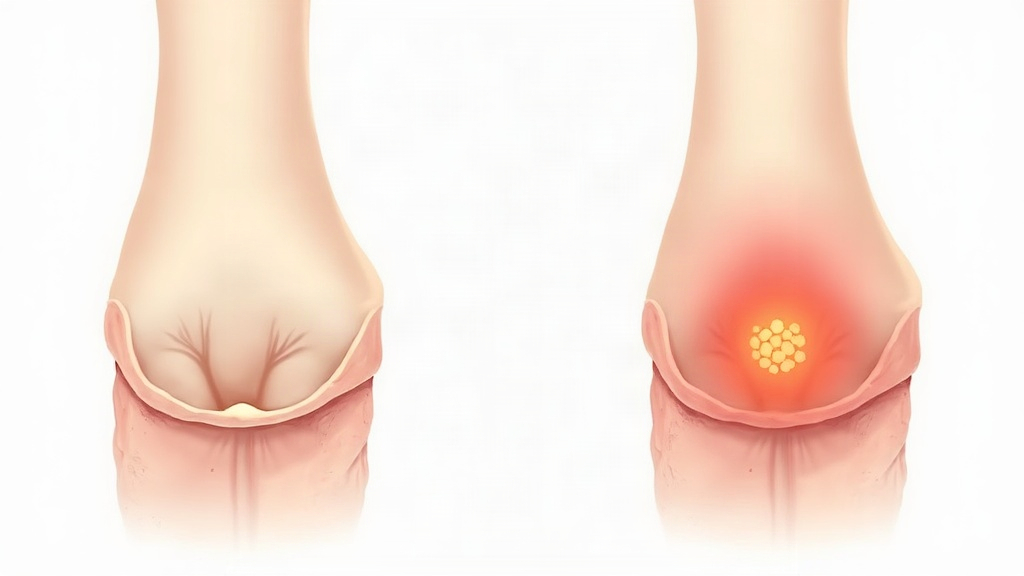
The immune driver is the IL-23/IL-17 axis, the same pathway that builds psoriasis plaques, along with TNF. Modern biologics block these signals directly. Diet and supplements nudge the same inflammation from the outside, but with far less force.
PsA also behaves differently in the clinic. Blood markers can be normal in active disease. Rheumatoid factor and anti-CCP are usually negative. That makes it easy to miss, and missing it is costly.
PsA vs RA: a quick differentiator
A guide for the conversation with your doctor, not a diagnostic tool. Overlap exists, and a rheumatologist makes the call.
| Feature | Psoriatic arthritis | Rheumatoid arthritis |
|---|---|---|
| Skin and nails | Psoriasis in the patient or a close relative; nail pitting or lifting is common | No psoriasis link; nails usually normal |
| Joint pattern | Often asymmetric; can start in one or a few joints; end joints of fingers (DIP) involved | Symmetric; small joints of hands and feet; DIP joints usually spared |
| Dactylitis | Whole finger or toe swells like a sausage | Uncommon |
| Enthesitis | Pain where tendons attach: back of heel, sole of foot, elbow | Uncommon |
| Spine and back | Inflammatory back pain or sacroiliitis in a subset | Lower back usually spared (neck can be involved) |
| Blood tests | Rheumatoid factor and anti-CCP usually negative; CRP can be normal even in active disease | Rheumatoid factor and/or anti-CCP positive in most patients |
| X-ray signature | Erosions plus new bone formation; pencil-in-cup in advanced disease | Erosions with bone loss around joints; little new bone |
Skin and nails
PsA
Psoriasis in the patient or a close relative; nail pitting or lifting is common
RA
No psoriasis link; nails usually normal
Joint pattern
PsA
Often asymmetric; can start in one or a few joints; end joints of fingers (DIP) involved
RA
Symmetric; small joints of hands and feet; DIP joints usually spared
Dactylitis
PsA
Whole finger or toe swells like a sausage
RA
Uncommon
Enthesitis
PsA
Pain where tendons attach: back of heel, sole of foot, elbow
RA
Uncommon
Spine and back
PsA
Inflammatory back pain or sacroiliitis in a subset
RA
Lower back usually spared (neck can be involved)
Blood tests
PsA
Rheumatoid factor and anti-CCP usually negative; CRP can be normal even in active disease
RA
Rheumatoid factor and/or anti-CCP positive in most patients
X-ray signature
PsA
Erosions plus new bone formation; pencil-in-cup in advanced disease
RA
Erosions with bone loss around joints; little new bone
Have psoriasis? Bring these to your next appointment
Any one of these is worth mentioning. Two or more is a reason to ask for a rheumatology referral.
- A finger or toe that swelled up as a whole
- Heel or sole pain that is worst on the first steps of the morning
- Joint stiffness lasting more than 30 minutes after waking
- Nail pitting, ridging or nails lifting from the bed
- Back pain that improves with movement and wakes you in the second half of the night
Why Early DMARD or Biologic Treatment Comes First
This section is blunt because the stakes are permanent. Joint erosions in PsA do not grow back. No diet, supplement or peptide has been shown to prevent them. Prescription treatment has.
In an Irish cohort of 283 PsA patients, a delay of more than 6 months from first symptoms to the first rheumatology visit was associated with peripheral joint erosions (OR 4.25) and worse long-term physical function (Haroon, Gallagher and FitzGerald, Annals of the Rheumatic Diseases 2015). The median delay in that cohort was a full year.
The TICOPA trial tested what happens when early PsA is treated aggressively. Researchers randomized 206 patients with symptoms for less than two years to tight control (review every 4 weeks, escalate treatment until minimal disease activity) or standard care. Tight control raised the odds of an ACR20 response at 48 weeks (OR 1.91, 95% CI 1.03 to 3.55) and improved skin outcomes too (Coates et al., Lancet 2015). Serious adverse events were more frequent in the tight-control arm, a real trade-off your rheumatologist will weigh with you.
The 2018 ACR/National Psoriasis Foundation guideline backs a treat-to-target approach and favors TNF inhibitors as a first-line option for active, treatment-naive PsA. Other classes include methotrexate and other conventional DMARDs, IL-17 and IL-23 inhibitors, apremilast and JAK inhibitors. Which one fits depends on whether your disease is mainly in the joints, spine, entheses, skin or gut.
Do not swap medication for supplements
Stopping a DMARD or biologic on your own can trigger a flare and allow damage that cannot be reversed. If you want to reduce medication, the time to discuss it is after sustained remission, with your rheumatologist, using a planned taper.
How We Grade the Evidence
Multiple RCTs or meta-analyses
Consistent results in PsA patients. Here, only prescription treat-to-target care reaches this bar.
Single RCT or strong clinical data
At least one controlled trial or large registry in PsA with a clear, clinically relevant signal.
Preliminary or extrapolated
Observational, mechanistic, or borrowed from skin psoriasis or RA trials.
Psoriatic arthritis: evidence by intervention
Graded for effect on joints, function and treatment response in PsA specifically. Skin-only psoriasis data are noted where they fill gaps.
| Intervention | Grade | Effect | Key evidence | Notes |
|---|---|---|---|---|
| Early DMARD / biologic treatment (treat-to-target) | Grade A | Prevents erosions and preserves function | TICOPA RCT (Coates 2015, Lancet, n=206): tight control raised odds of ACR20 at 48 weeks (OR 1.91). Haroon 2015: a 6-month delay to rheumatology linked to erosions and worse function. | The foundation. Every option below is an add-on to this, never a swap. |
| Weight loss (if overweight) | Grade B | Higher odds of minimal disease activity; dose-response | Di Minno 2014 (n=138 on TNF blockers): 5-10% loss OR 3.75 for MDA, over 10% loss OR 6.67. Klingberg 2019 (n=41, open-label): about 19% loss, MDA rose from 29% to 54%. | The strongest lifestyle lever in PsA. Medical weight-loss options belong in the conversation. |
| Smoking cessation | Grade B | Better and longer-lasting biologic response | DANBIO registry (Hojgaard 2015, n=1,388): current smokers had shorter TNF-inhibitor drug survival and lower response rates, most clearly in men. | Strong recommendation in the 2018 ACR/NPF guideline. |
| Exercise and physiotherapy | Grade B | Less fatigue, better fitness, no flare signal | Thomsen 2019 RCT (n=67): 11 weeks of HIIT reduced fatigue without worsening disease activity; a companion analysis (RMD Open 2018) found higher VO2max and lower truncal fat. Disease activity itself did not change. | Low-impact work for enthesitis-heavy disease. Physio for hands and heels. |
| Omega-3 fish oil (3 g/day) | Grade B | Less painkiller use; disease score not significantly better | Kristensen 2018 RCT (n=145, 24 weeks): NSAID and paracetamol use fell vs olive oil (p=0.04); LTB4 fell; DAS28-CRP difference not significant. | A realistic adjunct for pain and cardiovascular risk. Not a disease-modifier. |
| Mediterranean diet | Grade C | Lower disease activity in adherent patients (association) | Caso 2020 (n=211, cross-sectional): higher PREDIMED adherence linked to lower DAPSA. No PsA-specific RCT yet. | Stronger RCT data exist in skin psoriasis. Doubles as a weight-loss and heart-risk tool. |
| Vitamin D3 | Grade C | Correct deficiency; no proven effect on joints | A 2020 meta-analysis of vitamin trials in inflammatory rheumatic disease found no PsA trials to include. | Test, then replete. Bone protection matters if you take steroids. |
| Curcumin | Grade C | Unknown in PsA joints | No PsA randomized trial. In vitro data in PsA immune cells plus RA and skin-psoriasis trials. | Rare liver-injury reports. Extra caution on methotrexate or leflunomide. |
| Gut microbiome / probiotics | Grade C | Plausible mechanism, no clinical proof | Scher 2015: lower gut diversity and loss of Akkermansia and Ruminococcus in untreated PsA (n=16). | Fiber and fermented foods are reasonable. No probiotic strain has PsA trial data. |
| Stress reduction | Grade C | May reduce perceived flares and pain | Mostly extrapolated from psoriasis skin data and general chronic-pain research. | Sleep and pain management count here too. |
| Replacing DMARDs with supplements or diet | Avoid | Risk of permanent joint damage | No natural intervention has shown radiographic protection in PsA. Erosions do not reverse. | Discuss tapering only with your rheumatologist, after sustained remission. |
Early DMARD / biologic treatment (treat-to-target)
Grade APrevents erosions and preserves function
TICOPA RCT (Coates 2015, Lancet, n=206): tight control raised odds of ACR20 at 48 weeks (OR 1.91). Haroon 2015: a 6-month delay to rheumatology linked to erosions and worse function.
The foundation. Every option below is an add-on to this, never a swap.
Weight loss (if overweight)
Grade BHigher odds of minimal disease activity; dose-response
Di Minno 2014 (n=138 on TNF blockers): 5-10% loss OR 3.75 for MDA, over 10% loss OR 6.67. Klingberg 2019 (n=41, open-label): about 19% loss, MDA rose from 29% to 54%.
The strongest lifestyle lever in PsA. Medical weight-loss options belong in the conversation.
Smoking cessation
Grade BBetter and longer-lasting biologic response
DANBIO registry (Hojgaard 2015, n=1,388): current smokers had shorter TNF-inhibitor drug survival and lower response rates, most clearly in men.
Strong recommendation in the 2018 ACR/NPF guideline.
Exercise and physiotherapy
Grade BLess fatigue, better fitness, no flare signal
Thomsen 2019 RCT (n=67): 11 weeks of HIIT reduced fatigue without worsening disease activity; a companion analysis (RMD Open 2018) found higher VO2max and lower truncal fat. Disease activity itself did not change.
Low-impact work for enthesitis-heavy disease. Physio for hands and heels.
Omega-3 fish oil (3 g/day)
Grade BLess painkiller use; disease score not significantly better
Kristensen 2018 RCT (n=145, 24 weeks): NSAID and paracetamol use fell vs olive oil (p=0.04); LTB4 fell; DAS28-CRP difference not significant.
A realistic adjunct for pain and cardiovascular risk. Not a disease-modifier.
Mediterranean diet
Grade CLower disease activity in adherent patients (association)
Caso 2020 (n=211, cross-sectional): higher PREDIMED adherence linked to lower DAPSA. No PsA-specific RCT yet.
Stronger RCT data exist in skin psoriasis. Doubles as a weight-loss and heart-risk tool.
Vitamin D3
Grade CCorrect deficiency; no proven effect on joints
A 2020 meta-analysis of vitamin trials in inflammatory rheumatic disease found no PsA trials to include.
Test, then replete. Bone protection matters if you take steroids.
Curcumin
Grade CUnknown in PsA joints
No PsA randomized trial. In vitro data in PsA immune cells plus RA and skin-psoriasis trials.
Rare liver-injury reports. Extra caution on methotrexate or leflunomide.
Gut microbiome / probiotics
Grade CPlausible mechanism, no clinical proof
Scher 2015: lower gut diversity and loss of Akkermansia and Ruminococcus in untreated PsA (n=16).
Fiber and fermented foods are reasonable. No probiotic strain has PsA trial data.
Stress reduction
Grade CMay reduce perceived flares and pain
Mostly extrapolated from psoriasis skin data and general chronic-pain research.
Sleep and pain management count here too.
Replacing DMARDs with supplements or diet
AvoidRisk of permanent joint damage
No natural intervention has shown radiographic protection in PsA. Erosions do not reverse.
Discuss tapering only with your rheumatologist, after sustained remission.
Grade A: multiple RCTs or meta-analyses. Grade B: single RCT or strong clinical data. Grade C: observational, mechanistic or extrapolated. Discuss every change with your rheumatologist.
Psoriatic Arthritis Weight Loss: The Strongest Lever You Control [Grade B]
Obesity is more common in PsA than in the general population, and fat tissue is not inert. It releases TNF, IL-6 and leptin, the same inflammatory signals the biologics target. Excess weight also loads the entheses of the knees, heels and feet, which are exactly the sites PsA attacks.
The first controlled data came from Italy. Di Minno and colleagues followed 138 overweight or obese PsA patients starting TNF blockers and assigned them to a hypocaloric diet or a self-managed diet for 6 months. The hypocaloric group reached minimal disease activity (MDA) more often (HR 1.85). Compared with losing less than 5 percent of body weight, losing 5 to 10 percent raised the odds of MDA (OR 3.75), and losing more than 10 percent raised them further (OR 6.67) (Di Minno et al., Annals of the Rheumatic Diseases 2014).
Klingberg's Swedish study pushed the dose higher. Forty-one patients with PsA and a BMI of at least 33 completed a very low energy diet of 640 kcal a day for 12 to 16 weeks, with medication held constant. Median weight loss was 18.7 kg, about 18.6 percent of starting weight. MDA rose from 29 to 54 percent, and larger losses brought larger gains (Klingberg et al., Arthritis Research & Therapy 2019). The study had no control group, so it supports the dose-response picture rather than proving it.
How you lose the weight matters less than keeping it off. A Mediterranean-style eating pattern, protein at each meal to protect muscle, and resistance training are a sound base. Very low energy diets should be medically supervised. For people with obesity who cannot lose weight through diet alone, GLP-1 receptor agonists are a reasonable discussion with your doctor; we cover the anti-inflammatory data in our GLP-1 and autoimmune inflammation guide.
The Psoriatic Arthritis Diet: What the Data Support
Mediterranean Diet [Grade C in PsA]
In 211 Italian PsA patients, higher adherence to the Mediterranean diet on the PREDIMED questionnaire was independently associated with lower disease activity on the DAPSA score (B = -3.29) (Caso et al., Rheumatology International 2020). The study was cross-sectional, so people with milder disease may simply eat better.
The grade stays at C for joints, but the case for the diet is wider than one score. PsA carries higher cardiovascular risk than the general population, and the Mediterranean pattern is the best-tested diet for heart outcomes. In skin psoriasis, randomized data are stronger; we cover the MEDIPSO trial in our psoriasis diet and natural treatment guide and specific food triggers in the psoriasis diet guide.
A practical PsA plate looks like this:
- Fatty fish two to three times a week (salmon, sardines, mackerel)
- Extra virgin olive oil as the main fat
- Vegetables, legumes and whole grains for fiber that feeds gut bacteria
- Nuts and seeds daily in small amounts
- Less red and processed meat, sugary drinks, refined flour and ultra-processed snacks
Gluten-Free, AIP and Elimination Diets [Grade C]
Gluten-free eating has a clear rationale only for people with celiac disease or anti-gliadin antibodies, a subset that is overrepresented in psoriatic disease. Ask for a celiac panel before cutting gluten, since testing after removal gives false negatives. Our gluten and joint inflammation article covers the mechanisms.
The autoimmune protocol and other strict elimination diets have no PsA trials. They can make sense as a short, structured experiment, but they are hard to sustain and can work against weight loss goals if they push you toward calorie-dense foods. See our autoimmune diet comparison for how the options stack up. If you share features with axial disease or carry HLA-B27, our HLA-B27 diet guide covers the low-starch hypothesis.
Supplements for Psoriatic Arthritis
The supplement evidence in PsA is thinner than most websites admit. Much of what circulates is borrowed from skin psoriasis or rheumatoid arthritis. We grade on PsA data first and say when we are extrapolating. For skin-focused supplement doses and stacking, see our psoriasis supplements guide.
Omega-3 Fish Oil for Psoriatic Arthritis [Grade B]
The best omega-3 psoriatic arthritis trial is Danish. Kristensen and colleagues randomized 145 patients with established PsA to 3 g of marine omega-3 or 3 g of olive oil daily for 24 weeks; 133 completed. The disease activity score (DAS28-CRP) fell in the omega-3 group, but not significantly more than in controls. Use of NSAIDs and paracetamol dropped significantly compared with controls (p = 0.04), and leukotriene B4, a potent inflammatory signal from white blood cells, fell sharply (p = 0.004) (Kristensen et al., Scandinavian Journal of Rheumatology 2018).
The trial dose was 3 g of combined omega-3 per day. Check the label for EPA plus DHA content, not total fish oil. Fish oil can modestly thin the blood; discuss it if you take anticoagulants or have surgery planned. In RA, where the omega-3 evidence is stronger, fish oil added to methotrexate improved remission rates; we cover that in our RA supplements guide.
Vitamin D [Grade C; correct deficiency]
Low vitamin D is common in psoriatic disease, and topical vitamin D analogues are a standard skin treatment. For joints, the trial evidence is missing. A 2020 meta-analysis of oral vitamin supplementation in inflammatory rheumatic disease screened for PsA and spondyloarthritis trials and found none to include (Nguyen et al., Nutrients 2020).
The VITAL trial (2022) found that 2,000 IU of vitamin D3 a day reduced new autoimmune disease diagnoses by about 22 percent over five years, with psoriasis among the conditions counted. That is prevention data in older adults, not treatment data for established PsA. Test your 25(OH)D level, replete if low, and recheck. Bone protection is a real reason to stay replete if you take or have taken steroids.
Curcumin [Grade C]
Curcumin reduces IFN-gamma production by T cells and NK cells taken from PsA patients in the lab, and it has positive small trials in RA and skin psoriasis. There is no randomized trial of curcumin in PsA joints. Our curcumin for RA article reviews the RA data in detail, including a trial in which curcumin could not replace DMARDs.
The safety caveat matters more in PsA than in many conditions. Turmeric and curcumin supplements, especially high-bioavailability formulations, have been linked to rare cases of drug-induced liver injury in the NIH LiverTox database. Methotrexate and leflunomide also stress the liver, and fatty liver is common in psoriatic disease. If you want to try curcumin, tell your rheumatologist and keep your scheduled liver tests.
Probiotics and the Gut Microbiome [Grade C]
The gut is part of the PsA story. Scher and colleagues sequenced stool from 16 patients with untreated, recent-onset PsA and found lower bacterial diversity than in healthy controls, with a specific drop in Akkermansia and Ruminococcus that resembled the pattern seen in inflammatory bowel disease (Scher et al., Arthritis & Rheumatology 2015). PsA is also associated with higher rates of inflammatory bowel disease and with subclinical gut inflammation.
No probiotic strain has been tested in a PsA trial. Feeding a diverse microbiome with fiber, legumes and fermented foods is low-risk and fits the Mediterranean pattern. For strain-level evidence across autoimmune conditions, see our probiotics for autoimmune disease guide. If you have persistent diarrhea, blood in stool or weight loss, get evaluated; IL-17 inhibitors in particular can unmask or worsen IBD.
Exercise and Physiotherapy [Grade B]
People with PsA often fear that exercise will trigger a flare. The best trial says otherwise. Thomsen and colleagues in Norway randomized 67 PsA patients to 11 weeks of high-intensity interval training or their usual activity. HIIT did not worsen disease activity and the exercise group reported meaningfully less fatigue (Thomsen et al., Arthritis Care & Research 2019). A companion analysis of the same trial found higher aerobic fitness (VO2max) and lower truncal fat after HIIT (Thomsen et al., RMD Open 2018), and a 2023 ultrasound and MRI analysis found no clear increase in objectively measured joint or enthesis inflammation (Thomsen et al., BMC Musculoskeletal Disorders 2023).
The same trial found no direct drop in disease activity scores. Exercise earns its grade through fatigue, fitness, body composition and cardiovascular protection, which are all major problems in PsA.
The 2018 ACR/NPF guideline recommends exercise over no exercise for active PsA, favors low-impact activities such as tai chi, yoga and swimming, and lists physical therapy, occupational therapy, massage and acupuncture as options. A sensible week:
- Two to three sessions of resistance training to protect muscle during weight loss
- Low-impact cardio on most days: cycling, swimming, brisk walking
- Mobility work for the spine and hips if you have back involvement; our ankylosing spondylitis self-care guide has detailed axial routines
- Short HIIT blocks once you are stable, if you enjoy them
Enthesitis changes the plan. If your heels or soles are inflamed, swap running and jumping for cycling or pool work, and ask for a physiotherapist who can address footwear, insoles and tendon loading. Hand therapists can provide splints and joint-protection strategies for dactylitis and DIP joint disease.
Smoking and Alcohol
Smoking [Grade B]
Smoking has an odd relationship with psoriatic disease, but its effect on treatment is clear. In the Danish DANBIO registry of 1,388 PsA patients starting a first TNF inhibitor, current smokers stayed on their biologic for a shorter time and had lower ACR and EULAR response rates, with the effect most pronounced in men (Højgaard et al., Annals of the Rheumatic Diseases 2015). Smokers also started treatment with worse function, fatigue and global health scores.
The 2018 ACR/NPF guideline gives smoking cessation a strong recommendation, one of the few strong recommendations in the document. Nicotine replacement, varenicline and behavioral support are all compatible with PsA treatment; ask your doctor which fits.
Alcohol [Grade C]
Alcohol worsens psoriasis skin disease and interacts with the liver burden of methotrexate. The best quantitative data come from RA, not PsA: in 11,839 RA patients starting methotrexate in UK primary care, drinking up to 14 units a week did not raise the rate of significant liver enzyme elevation, while more than 21 units a week nearly doubled it (HR 1.85) (Humphreys et al., Annals of the Rheumatic Diseases 2017).
Psoriatic disease carries extra liver risk through obesity and fatty liver, so many rheumatologists set a lower limit for PsA patients on methotrexate. Ask for your personal number. Alcohol also adds calories that undercut weight loss, the lever that matters most.
Stress, Sleep and Pain [Grade C]
Many PsA patients notice flares after stressful periods. The best data for stress-reduction come from skin psoriasis, where mindfulness-based programs have shown faster clearing during phototherapy. We review those trials in the psoriasis diet and natural treatment guide rather than repeating them here.
For joints, the honest grade is C. Even so, poor sleep and chronic pain amplify each other, and fatigue in PsA often persists after inflammation is controlled. Cognitive behavioral therapy for insomnia, a regular sleep window, and pacing during flares are low-risk and worth trying. If pain remains high while your inflammatory markers and joint counts look quiet, ask whether central sensitization or fibromyalgia is part of the picture, because it changes the treatment plan.
Psoriatic Arthritis Home Remedies: What Doesn't Work (or Isn't Proven)
Some popular remedies have no PsA evidence at all, and a few carry real risk.
- Replacing DMARDs with diet or supplements. No natural intervention has shown protection against radiographic progression in PsA. This is the single most damaging mistake.
- Apple cider vinegar, alkaline diets and "detox" cleanses. No PsA data. Cleanses that drop calories hard can cause muscle loss and rebound weight gain.
- Immune-stimulating herbs. Echinacea, elderberry, spirulina and similar products are marketed as immune boosters. In an immune-mediated disease, and on top of immunosuppressive drugs, that is the wrong direction. Our best supplements for autoimmune disease guide lists what to avoid.
- Epsom salt baths and capsaicin cream. Fine for comfort. Not disease-modifying.
- CBD. Trial data in PsA are lacking, and CBD can raise levels of some drugs through liver enzymes.
- Peptides like BPC-157 for joints. Animal tendon data only, no human PsA trials, and not FDA-approved.
Low dose naltrexone has small studies in other autoimmune conditions and none in PsA. If you are curious, our LDN for autoimmune disease guide explains the evidence and how it fits with other treatment.
Drug-Supplement Interactions with Methotrexate and Biologics
Most PsA patients who use supplements also take prescription drugs. These are the interactions worth raising with your rheumatologist or pharmacist.
| Medication | Watch out for | What to do |
|---|---|---|
| Methotrexate | Alcohol, turmeric/curcumin, kava, high-dose niacin, green tea extract (liver stress). Trimethoprim antibiotics (bone marrow toxicity). | Take the folic acid your doctor prescribes. Keep liver and blood tests on schedule. Ask before adding any herbal product. |
| Leflunomide | Same liver-stressing supplements and alcohol as methotrexate. | Same precautions as methotrexate. |
| TNF, IL-17, IL-23 inhibitors | Immune-stimulating herbs (echinacea, astragalus). Live vaccines. | Avoid immune boosters. Check vaccines with your doctor before you get them. Report signs of infection early. |
| Apremilast (Otezla) | St. John's wort and other strong CYP3A4 inducers lower drug levels (per the label, rifampin cut exposure by about 72 percent). | Do not combine with St. John's wort. Mention any mood supplement. |
| JAK inhibitors (tofacitinib, upadacitinib) | St. John's wort (CYP3A4 induction lowers drug levels); grapefruit (CYP3A4 inhibition raises them; the upadacitinib label says to avoid it). | Check every new supplement against your JAK inhibitor. |
| NSAIDs | High-dose fish oil, ginkgo, garlic extract, vitamin E (added bleeding risk). | Usually fine at standard doses; disclose them, especially before surgery. |
Fish oil, vitamin D at moderate doses and magnesium have no meaningful interactions with methotrexate or biologics. The RA supplements guide linked above covers methotrexate and folate timing in more depth.
Putting It Together: A PsA Adjunct Plan
- See a rheumatologist early and agree on a treatment target, such as minimal disease activity.
- Lose weight if you need to. Aim for 5 to 10 percent first; more if your doctor supports it.
- Stop smoking. Use every tool available.
- Move most days. Combine strength training with low-impact cardio, and get physio for heels, hands or spine.
- Eat a Mediterranean-style diet sized for your weight goal, with fatty fish two to three times a week.
- Consider 3 g/day omega-3 for pain and heart health, after checking with your doctor.
- Test vitamin D and correct deficiency.
- Review alcohol and supplements against your medication list.
Psoriatic arthritis protocols differ by phenotype. Someone with dactylitis and nail disease needs a different plan from someone with axial back pain or gut symptoms. If your arthritis has features of both PsA and RA, our RA diet guide is a useful companion.
Frequently Asked Questions
Can psoriatic arthritis be treated naturally?
Natural measures help, but they do not control PsA on their own in most people. Weight loss, smoking cessation, exercise and fish oil have the best evidence as add-ons. None has been shown to prevent the erosions that early DMARD or biologic treatment prevents.
What is the best diet for psoriatic arthritis?
A calorie-appropriate Mediterranean pattern. Higher adherence is linked to lower disease activity, and in overweight patients the weight loss itself drives most of the benefit. Gluten-free eating helps the subset with celiac antibodies.
Does losing weight help psoriatic arthritis?
Yes. Losing 5 to 10 percent of body weight raised the odds of minimal disease activity 3.75-fold in overweight patients starting TNF blockers, and more than 10 percent raised it 6.67-fold (Di Minno 2014).
Which supplements for psoriatic arthritis have real evidence?
Omega-3 fish oil has the only PsA-specific randomized trial, and it reduced painkiller use rather than disease activity. Vitamin D is worth testing and correcting. Curcumin and probiotics are unproven in PsA joints.
How do I know if my psoriasis is turning into psoriatic arthritis?
Watch for a swollen whole finger or toe, heel or sole pain worst on the first steps of the morning, morning stiffness over 30 minutes, nail pitting or lifting, and back pain that eases with movement. Two or more is a reason to ask for a rheumatology referral. Screening questionnaires such as PEST are used by dermatologists for this purpose.
Is exercise safe during a PsA flare?
Gentle movement is safe and helps stiffness. Drop the intensity, favor swimming, cycling or stretching, and avoid high-impact loading of inflamed heels or knees until the flare settles.
Build Your Personalized PsA Protocol
PsA rewards a plan built around your pattern: skin, nails, joints, entheses, spine or gut. Take the free 3-minute AutoimmuneFinder quiz to get an evidence-graded protocol matched to your condition, your medications and your severity, with interactions flagged before you start anything new.
This site provides educational information only. Not medical advice. Always consult your healthcare provider before changing your treatment plan. Psoriatic arthritis can cause permanent joint damage without timely treatment. Natural interventions are complementary to rheumatology care, not substitutes for it. Discuss any dose or supplement with your doctor, especially if you take methotrexate, leflunomide, apremilast, a JAK inhibitor or a biologic.